Classification and working process of filter press
Release time:
Apr 24,2022
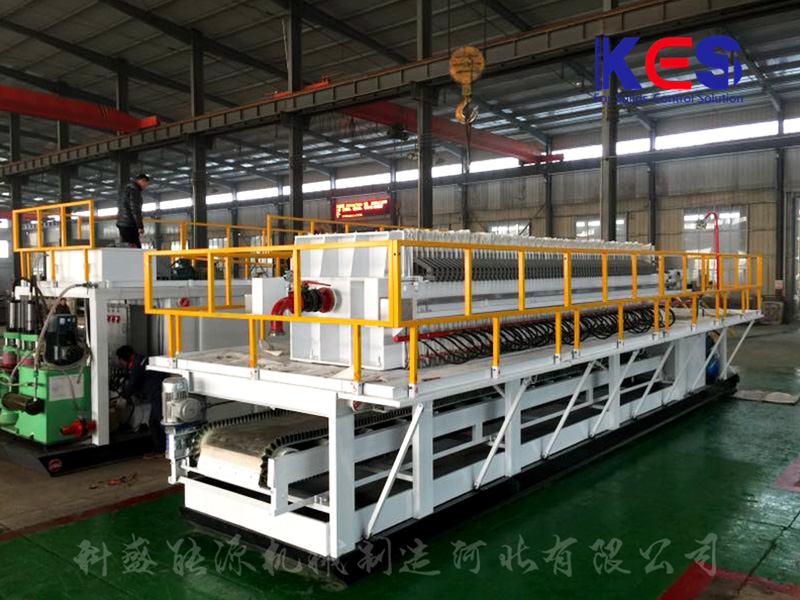
The filter press is generally composed of head plate, tail plate, filter plate, hydraulic cylinder, main beam, transmission and pulling device. The hydraulic cylinder piston pushes the head plate, so that the filter plate is pressed against the adjacent filter plate to form a filter chamber; the mud is sent into the filter chamber by the mud pump, the water is discharged through the filter cloth through the drain port, and the solid mud forms a filter cake in the filter chamber. When the mud is filled with the filter chamber, the mud is pressurized and filtered by the high-pressure pump to separate the solid and liquid in the filter chamber.
Classified according to the filtering method: chamber filter press, plate and frame filter press, belt filter press, diaphragm filter press;
According to the structure classification: suspension beam filter press and belt filter press;
According to the pressure classification: hydraulic compression, manual jack compression, mechanical compression.
The filter press is generally composed of head plate, tail plate, filter plate, hydraulic cylinder, main beam, transmission and pulling device. The hydraulic cylinder piston pushes the head plate, so that the filter plate is pressed against the adjacent filter plate to form a filter chamber; the mud is sent into the filter chamber by the mud pump, the water is discharged through the filter cloth through the drain port, and the solid mud forms a filter cake in the filter chamber. When the mud is filled with the filter chamber, the mud is pressurized and filtered by the high-pressure pump to separate the solid and liquid in the filter chamber.
Step 1: Press the filter plate
Operate the hydraulic system to move the tail plate towards the head plate and press down all the filter plates between the head plate and the tail plate. Thus, a hollow sealed filter chamber is formed between the adjacent filter plates.
Step two: pressure filtration process
The feed pump transports the mud from the feed hole of the tail plate to the filter chamber. When the filter chamber is filled with mud, the pressure filtration process starts, and the mud is separated from the solid and liquid by the pressure of the feed pump.
In the early stage of pressure filtration, the thickness of the filter cake in the filter chamber is not large, the resistance of the filter cake is small, and the dehydration speed is fast. Usually, a pump with low head and large flow rate is used at this time. With the increase of the thickness of the filter cake and the increase of the resistance, the pressure filtration speed decreases, and the pump with high head and small flow rate is applied at this time. The time required for the pressure filtration process is determined according to the filtration characteristics and process requirements of the mud. When the pressure filtration time is reached, the feeding is stopped and the pressure filtration process is completed.
Step 3: Loosen the filter plate
Operate the hydraulic system to return the head plate to its original position.
Step four: filter plate unloading
The transmission chain on the transmission and pulling device will pull the filter plate one after another, and the filter cake will fall off by its own weight and be transported away by the lower conveyor.
Factors Affecting Performance
Pressure
The main factor affecting the filtering effect of the filter press is the control of pressure. As we all know, the main working principle of the filter press is to realize the filtering function through the control and adjustment of pressure, so the quality of the pressure system is directly related to the filtering effect. Good or bad.
Speed
Another factor affecting the performance of the filter press is the speed of filtration. Now many manufacturers are blindly pursuing the speed of product filtration and ignoring the essence of filtration. In fact, the use speed of the distribution machine should be considered and appropriate according to different factors such as the concentration and resistance of the liquid.
Filtration area
The filtering effect of the filter press is also affected by the filter area. As we all know, the larger the filter area, the faster the flow rate of objects passing through at the same time, the more residue will be taken away from it, and the worse the filtering effect will be. Of course, filters with the same density specifications are not as large as small areas, but this comparison method is not applicable to products with different mesh areas.
Recommended News
Share

Hebei Headquarters
Hotline: +86-400-999-3630
Tel: +86-316-5758058 +86-316-5758616
Fax: 0316-8933298
Email: sales@kessolidscontrol.com
Address: Industrial Road 2, Chaobai River Industrial Zone, Dachang County, Langfang City, Hebei Province